| # | Task ID | Domain | Subdomain | Prompt | GTFA | Image |
|---|
1
|
MM-HLE_4340
|
Physics
|
Electromagnetism
|
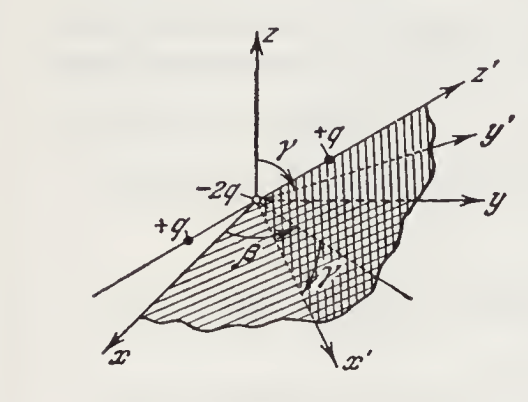
A static planar quadrupole consists of four discrete point charges situated in a vacuum. The charges are confined strictly to a diagonal plane defined by the condition $y = x$.The specific charge topography is as follows:Two positive charges, each of magnitude $+q$, are located on the $xy$-plane at Cartesian coordinates $(a/2, a/2, 0)$ and $(-a/2, -a/2, 0)$.Two negative charges, each of magnitude $-q$, are located on the $z$-axis at $(0, 0, a/2)$ and $(0, 0, -a/2)$.Derive the leading-order non-zero term for the far-field electrostatic scalar potential $\Phi$ in the asymptotic limit ($r \to \infty$). Express your final, fully simplified equation strictly in terms of the charge $q$, the length scale $a$, and standard spherical coordinates $(r, \vartheta, \alpha)$.
|
$$\Phi(r, \vartheta, \alpha) = \frac{qa^2}{4r^3} (3\sin^2\vartheta \sin 2\alpha - 3\cos 2\vartheta - 1)$$
|
|
2
|
MM-HLE_2146
|
Physics
|
Classical Mechanics
|
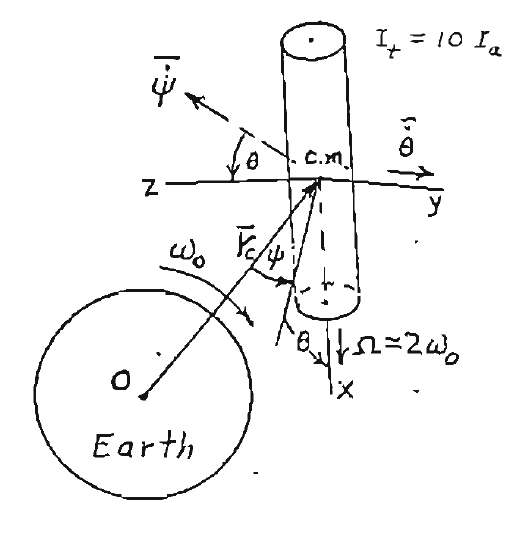
Analyze the rotational stability and dynamics of a gravity-gradient stabilized satellite, represented as a long slender rod of mass \(m\) and length \(l\) orbiting Earth, as shown in the figure.

 Calculate the steady-state (average) orientation angle of the satellite. Express the answer in degrees to three significant figures.

 Assume the satellite is in a circular orbit with constant angular velocity \(\omega_0\), the deviations \(\psi\) and \(\theta\) are small enough to justify linearization of the equations of motion, the satellite acts as a rigid body subject to gravity-gradient torques, and the spin rate \(\Omega\) uses the approximation shown in the figure. Use the linearized rotational equations of motion for a rigid body in a circular orbit.

 Definitions:

 * \(I_a\): Moment of inertia about the axis of symmetry (longitudinal axis).
 * \(I_t\): Moment of inertia about the transverse axes (\(I_t = \frac{1}{12}ml^2\)).
 * \(\omega_0\): Orbital angular velocity of the satellite around Earth.
 * \(\Omega\): Spin rate of the satellite about its axis of symmetry.
 * \(\psi, \theta\): Small deviation angles (yaw and pitch/roll) from the local vertical.
|
3.1
|
|
3
|
MM-HLE_6228
|
Physics
|
Thermodynamics & Statistical Mechanics
|
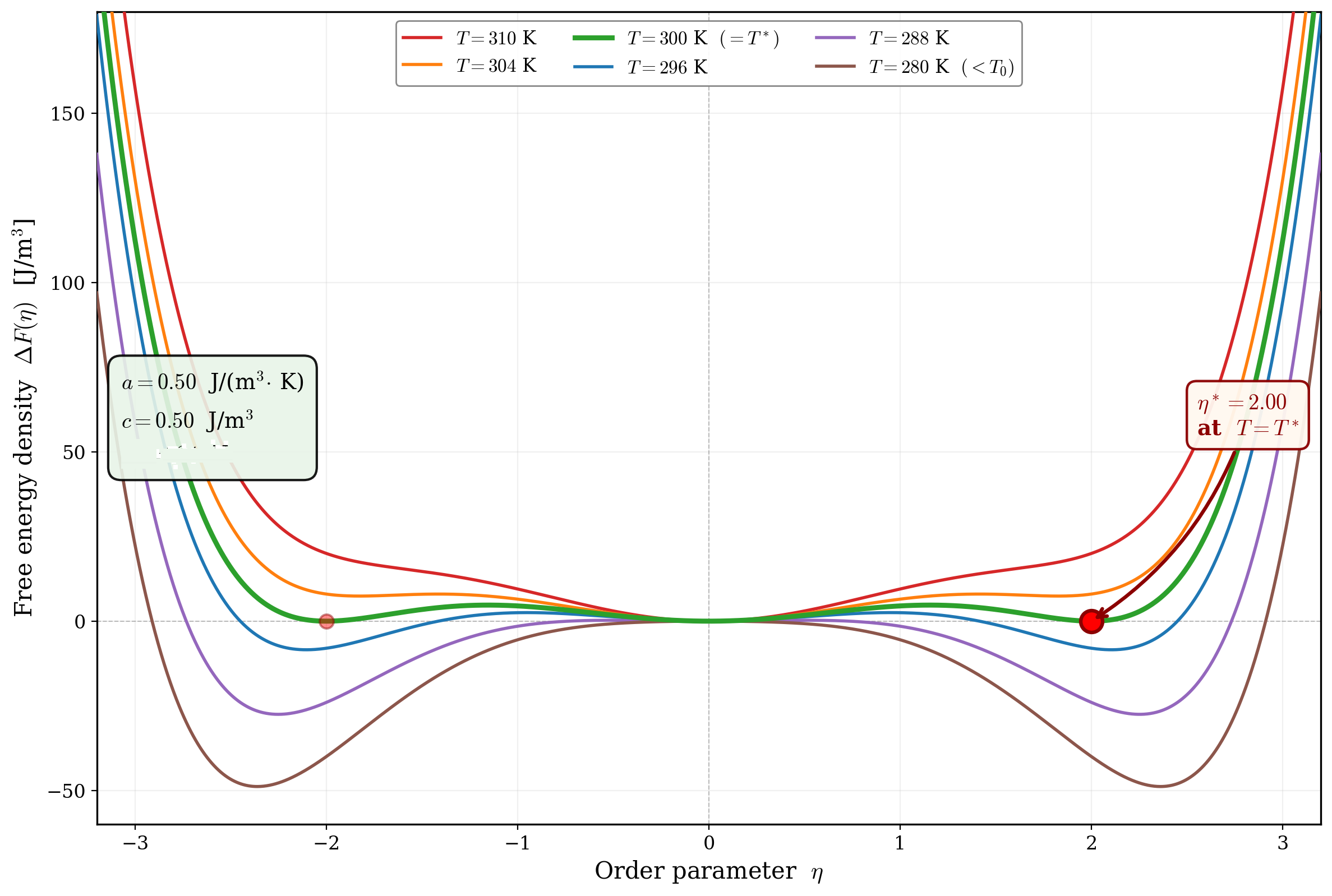
The figure depicts the Landau free energy density as a function of the order parameter for a material. Determine the latent heat per unit volume (in J/m³) released to nearest integer.
|
600
|
|
4
|
MM-HLE_2208
|
Physics
|
Fluid Dynamics
|
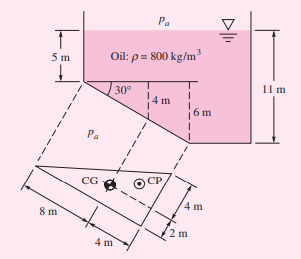
Refer to the attached figure. A right-triangular panel is submerged in oil of density
  \[
  \rho = 800\ \mathrm{kg/m^3},
  \]
  with
  \[
  g = 9.807\ \mathrm{m/s^2}.
  \]
  Neglect atmospheric pressure.

  Using only the geometric dimensions, inclination, depth location, and triangle orientation shown in the figure, determine the center of pressure of the triangular panel.

  Use hydrostatic-force theory for an inclined plane surface. In particular, determine the centroid depth below the free surface, the triangular area, and the centroidal second moments needed for the center-of-pressure calculation in coordinates aligned with the panel.

  Report the answer as the ordered pair
  \[
  (x_{CP},\,y_{CP}),
  \]
  where \(x_{CP}\) is the horizontal offset of the center of pressure from the panel centroid \(CG\), positive to the right as drawn, and \(y_{CP}\) is the offset of the center of pressure from \(CG\) measured along the panel, positive upward along the panel as drawn.

  Round both values to three decimal places.

  Output only
  \[
  (x_{CP},\,y_{CP})=(\text{value},\text{value})\ \mathrm{m}.
  \]
|
(0.111,-0.444)
|
|
5
|
MM-HLE_5847
|
Physics
|
Condensed Matter Physics
|
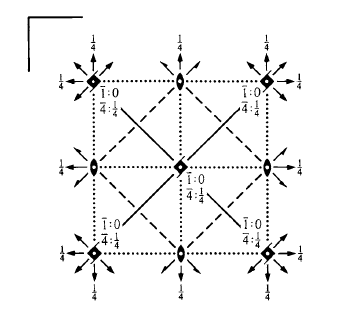
The figure shows a symmetry-element projection of a crystalline lattice, with the symmetric components explicitly labelled. From the diagram, Identify the corresponding space group (Hermann–Mauguin notation)
|
\(P4_2/mcm\)
|
|
6
|
MM-HLE_5179
|
Physics
|
Nuclear & Particle Physics
|
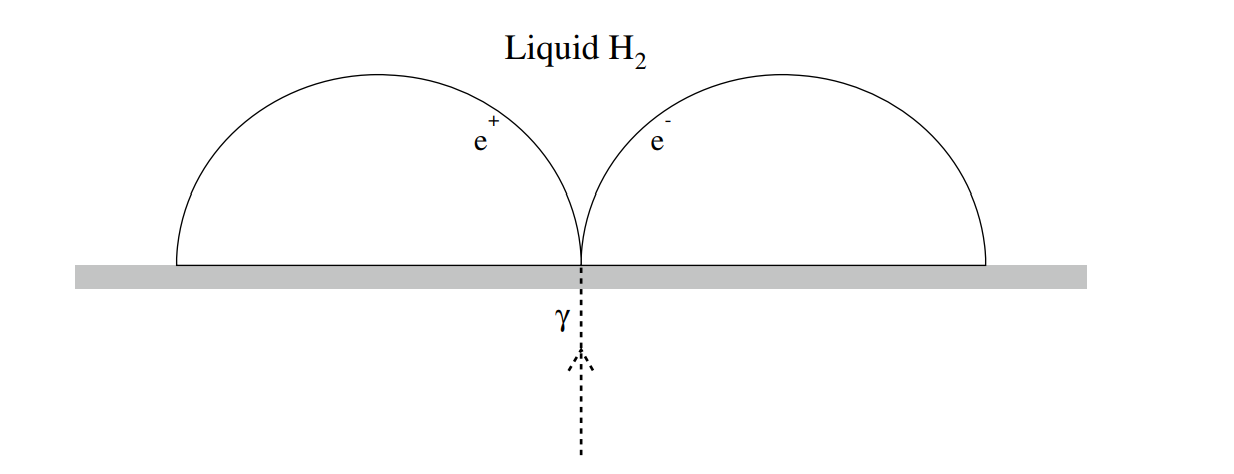
A photon strikes the wall of a liquid hydrogen bubble chamber (BC), resulting in the creation of an electron–positron pair, as illustrated in the given diagram. The magnetic field is $B = 0.8~\text{T}$ and is oriented perpendicular to the plane of the figure. The liquid hydrogen has a density of $\rho = 0.071~\text{g/cm}^3$. Within the chamber, the trajectories of the electron and positron appear as two oppositely curved arcs, each having a measured diameter of $80~\text{cm}$. Here, the diameter is defined as the straight-line distance between the entry and exit points of each particle. Estimate the photon energy including energy losses due to interaction in liquid hydrogen (ionization losses). Express the final photon energy in units of \(\mathrm{MeV}\) and report the value to three significant numbers.
|
234
|
|
7
|
MM-HLE_6311
|
Physics
|
Optics & Photonics
|
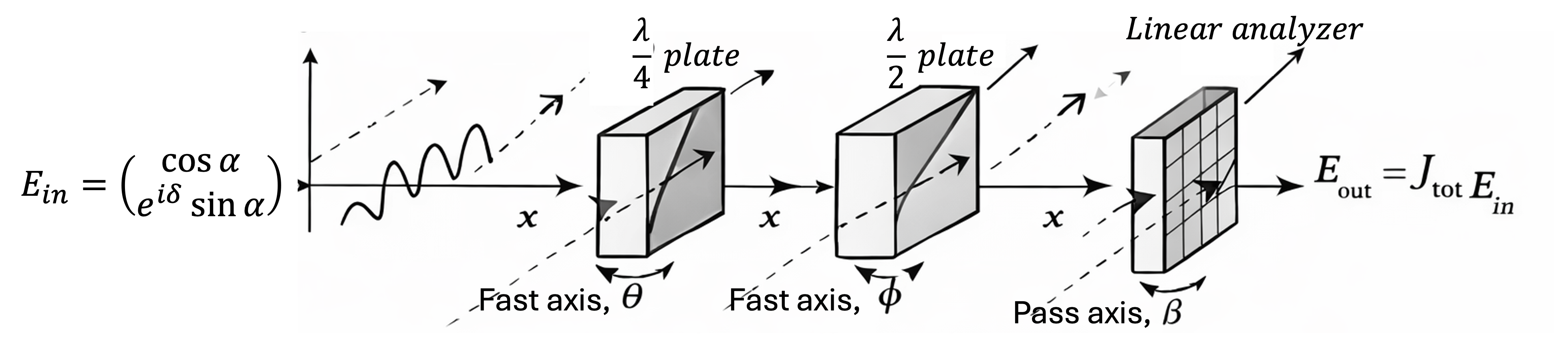
The attached figure shows a monochromatic plane wave propagating along the $+x$-axis. The electric field is expressed in the $(\hat y,\hat z)$ polarization basis and expressed by the Jones vector,

  \[\mathbf E_{\rm in}=\begin{pmatrix}
 \cos\alpha \\
 e^{i\delta}\sin\alpha
 \end{pmatrix} ,\]
 where $\alpha$ determines the amplitude ratio of the orthogonal components and $\delta$ is the relative phase.

 The plane wave propagates through the optical system as shown in the figure. Use the figure for the element order.

 The fast axes of retarders are aligned with the chosen polarization basis axes. Use Jones calculus for retarders defined by the rotation–sandwich convention,

 \[
 J_{\rm Retarder}=R(-\theta)\,
 J_{\rm \frac \lambda 4/\frac \lambda 2}\,
 R(\theta),
 \qquad
 R(\theta)=
 \begin{pmatrix}
 \cos\theta & -\sin\theta \\
 \sin\theta & \cos\theta
 \end{pmatrix}
 \], is the rotation matrix.

 Derive the exact analytical expression for the transmitted intensity as a function of \[\alpha,\delta,\theta,\phi,\beta\], after discarding the global phase. The final expression should be a linear combination of $\cos\psi$ and $\sin\psi$, where $\psi=(2\beta+4\phi-2\theta)$ with coefficients factored in $(\alpha,\delta,\theta)$.
|
\[ \frac12+\frac12\Big(\cos2\alpha\cos2\theta-\sin2\alpha\cos\delta\sin2\theta\Big)\cos\psi+\frac12\sin2\alpha\sin\delta\sin\psi \]
|
|
8
|
MM-HLE_7711
|
Physics
|
Astrophysics & Cosmology
|
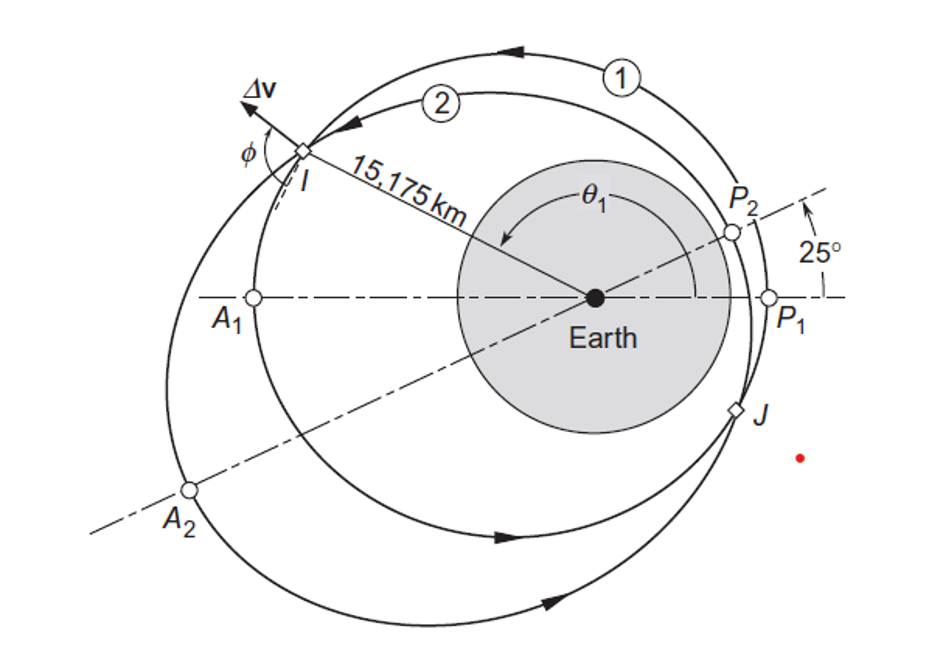
Use the orbital geometry exactly as labeled in the figure. Orbit \(1\) is the initial Earth-centered ellipse with perigee radius \(P_1=8000\,\mathrm{km}\) and apogee radius \(A_1=16{,}000\,\mathrm{km}\), and orbit \(2\) is the desired ellipse with perigee radius \(P_2=7000\,\mathrm{km}\) and apogee radius \(A_2=21{,}000\,\mathrm{km}\). The line of apsides of orbit \(2\) is rotated \(25^\circ\) counterclockwise from that of orbit \(1\), as shown. A single impulsive maneuver \(\Delta v\) is applied at the common intersection point \(I\) of the two ellipses, and the spacecraft is to transfer instantaneously from orbit \(1\) to orbit \(2\) at that point. Treat Earth as a point mass, use \(\mu_E=3.986\times10^5\,\mathrm{km^3/s^2}\), and neglect atmospheric drag, finite-burn effects, oblateness, and all third-body perturbations.

 Determine the angle \(\phi\) that the required impulse vector \(\Delta v\) makes with the local horizon at \(I\), with the positive sense of \(\phi\) taken exactly as indicated in the figure. Report \(\phi\) in degrees to four significant figures.
|
91.28
|
|
9
|
MM-HLE_1876
|
Physics
|
Quantum Mechanics
|
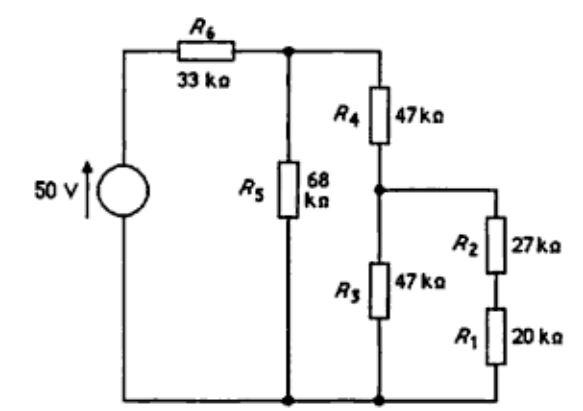
Consider the circuit shown in figure, where a 50 V source is connected to a resistor network. The voltage across resistor $R_1$ ($20 \text{ k}\Omega$) is measured using the 10 volt f.s.d. range of a 5,000 ohms-per-volt moving-coil multimeter. What percentage error has been introduced into the reading by the measurement method? Round off your answer to nearest integer value.
|
23
|
|
10
|
MM-HLE_1968
|
Physics
|
Other
|
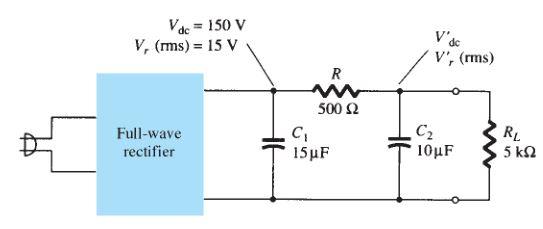
Consider the RC filter circuit shown in Figure, which is connected to the output of a full-wave rectifier. The unregulated input to the filter has a DC level of \(150\) V and an RMS ripple voltage of \(15\) V. The filter stage consists of a \(500\) \(\Omega\) series resistor (\(R\)) and a \(10\) \(\mu\)F shunt capacitor (\(C_2\)), feeding a load resistance \(R_L = 5\) k\(\Omega\).

 Calculate the ripple factor (\(r\)) of the output waveform across the load. Express your answer as a percentage, rounding to two decimal places.
|
2.86
|
|