| # | id | image | caption | metadata |
|---|
1
|
00000000___nmaahc_NMAAHC-2010_77_5
|
|
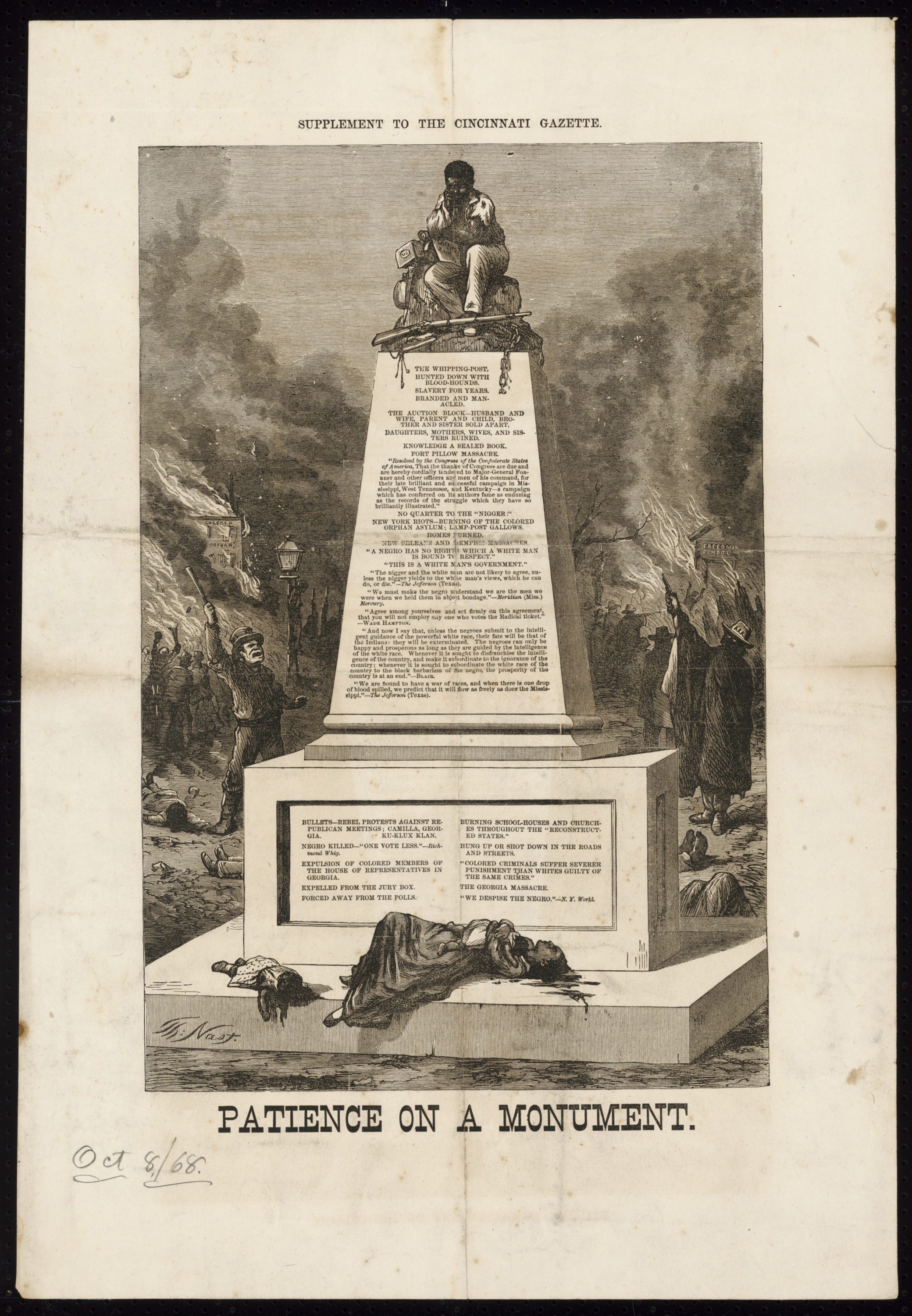
A rare broadside supplement to the Cincinnati Gazette, "Patience on a Monument," shows a freed slave sitting atop a monument that lists evils perpetrated against blacks. A dead woman and children lie at the bottom of the monument, while violence and fires rage in the background.
|
{"key": "nmaahc_NMAAHC-2010_77_5", "collection": "nmaahc", "tier": "tier1", "tier_path": "tier1/nmaahc", "record_id": "ld1-1643398738600-1643398743693-0", "type": "edanmdm", "title": "<I>Patience on a Monument</I>", "date": "October 8, 1868", "creator": "Thomas Nast, American, 1840 - 1902", "medium": "ink on newsprint | H x W: 18 5/8 x 13 in. (47.3 x 33 cm)", "place": "Cincinnati, Hamilton County, Ohio, United States, North and Central America", "object_type": "clippings", "topics": ["African American", "Emancipation", "Race relations", "Reconstruction, U.S. History, 1865-1877", "Violence"], "credit_line": "Collection of the Smithsonian National Museum of African American History and Culture", "data_source": "National Museum of African American History and Culture", "taxonomic_name": "", "notes_raw": [{"content": "A rare broadside supplement to the Cincinnati Gazette, \"Patience on a Monument,\" shows a freed slave sitting atop a monument that lists evils perpetrated against blacks. A dead woman and children lie at the bottom of the monument, while violence and fires rage in the background.", "label": "Description"}], "scopecontent": "", "alt_text": "", "ext_descr": "A rare broadside supplement to the Cincinnati Gazette, \"Patience on a Monument,\" shows a freed slave sitting atop a monument that lists evils perpetrated against blacks. A dead woman and children lie at the bottom of the monument, while violence and fires rage in the background. H x W: 18 5/8 x 13 in. (47.3 x 33 cm)", "caption_source": "notes", "grounding_prompt": "", "guid": "http://n2t.net/ark:/65665/fd54eb38045-4612-40e9-8580-479f02bbf14a", "license": "CC0", "image_path": "/capstor/store/cscs/swissai/infra01/vision-datasets/raw/cooldown/s3___smithsonian___OpenAccess/media/nmaahc/NMAAHC-2010_77_5.jpg", "image_width": 2080, "image_height": 3000, "all_idsIds": ["NMAAHC-2010_77_5"], "renders": {}}
|
2
|
00000001___nmaahc_NMAAHC-2015_80_2_5001
|
|
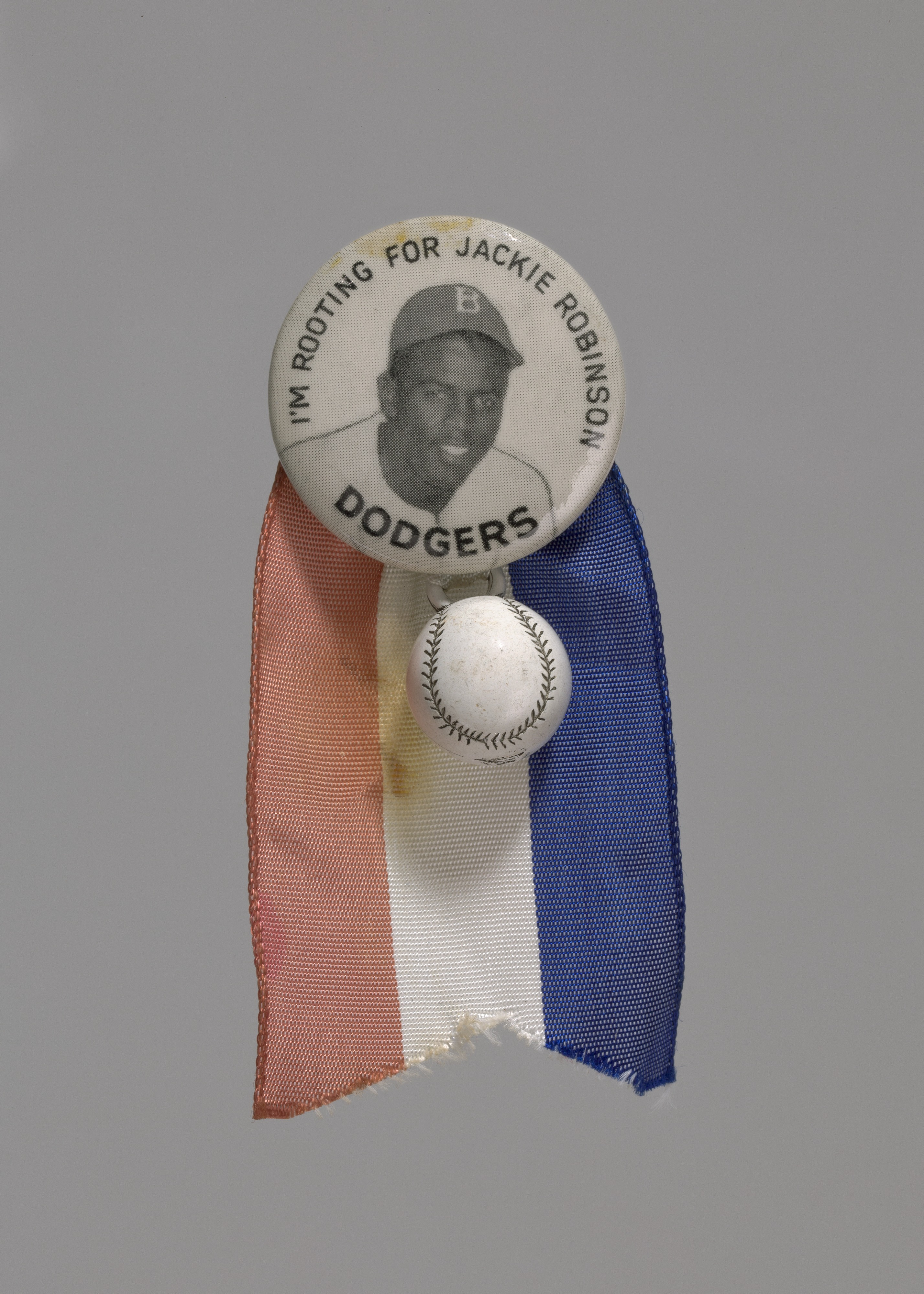
A metal pinback button featuring an image of Jackie Robinson with the words "I'M ROOTING FOR JACKIE ROBINSON" at the top and "DODGERS" at the bottom. Attached to the bottom of the pin is a small charm in the shape of a baseball. A red, white, and blue striped ribbon is attached to the back of the pin.
|
{"key": "nmaahc_NMAAHC-2015_80_2_5001", "collection": "nmaahc", "tier": "tier1", "tier_path": "tier1/nmaahc", "record_id": "ld1-1643398738600-1643398750466-0", "type": "edanmdm", "title": "Pinback button of Jackie Robinson with baseball charm and ribbon", "date": "1950s", "creator": "Unidentified | Jackie Robinson, American, 1919 - 1972 | Los Angeles Dodgers, American, founded 1883", "medium": "ink, metal, plastic and ribbon | Diameter (Pin Only): 1 1/2 × 1/8 in. (3.8 × 0.3 cm) | H x W x D (All): 3 1/16 × 1 9/16 × 3/4 in. (7.8 × 4 × 1.9 cm)", "place": "Brooklyn, New York City, New York, United States, North and Central America", "object_type": "buttons (information artifacts)", "topics": ["African American", "Athletes", "Baseball", "Sports"], "credit_line": "Collection of the Smithsonian National Museum of African American History and Culture", "data_source": "National Museum of African American History and Culture", "taxonomic_name": "", "notes_raw": [{"content": "A metal pinback button featuring an image of Jackie Robinson with the words [I'M ROOTING FOR JACKIE ROBINSON] at the top and [DODGERS] at the bottom. Attached to the bottom of the pin is a small charm in the shape of a baseball. A red, white, and blue striped ribbon is attached to the back of the pin.", "label": "Description"}], "scopecontent": "", "alt_text": "", "ext_descr": "Pinback button of Jackie Robinson with baseball charm and ribbon A metal pinback button featuring an image of Jackie Robinson with the words [I'M ROOTING FOR JACKIE ROBINSON] at the top and [DODGERS] at the bottom. Attached to the bottom of the pin is a small charm in the shape of a baseball. A red, white, and blue striped ribbon is attached to the back of the pin. Diameter (Pin Only): 1 1/2 × 1/8 in. (3.8 × 0.3 cm)\nH x W x D (All): 3 1/16 × 1 9/16 × 3/4 in. (7.8 × 4 × 1.9 cm)", "caption_source": "notes", "grounding_prompt": "", "guid": "http://n2t.net/ark:/65665/fd53a146528-b4bd-4f19-9ba8-47a71d25f6f0", "license": "CC0", "image_path": "/capstor/store/cscs/swissai/infra01/vision-datasets/raw/cooldown/s3___smithsonian___OpenAccess/media/nmaahc/NMAAHC-2015_80_2_5001.jpg", "image_width": 2856, "image_height": 4000, "all_idsIds": ["NMAAHC-2015_80_2_5001", "NMAAHC-F5EE008608EA2_2001", "NMAAHC-F5EE008608EA2_2002", "NMAAHC-2015_80_2_5002"], "renders": {}}
|
3
|
00000002___nmaahc_NMAAHC-2007_3_906_001
|
|
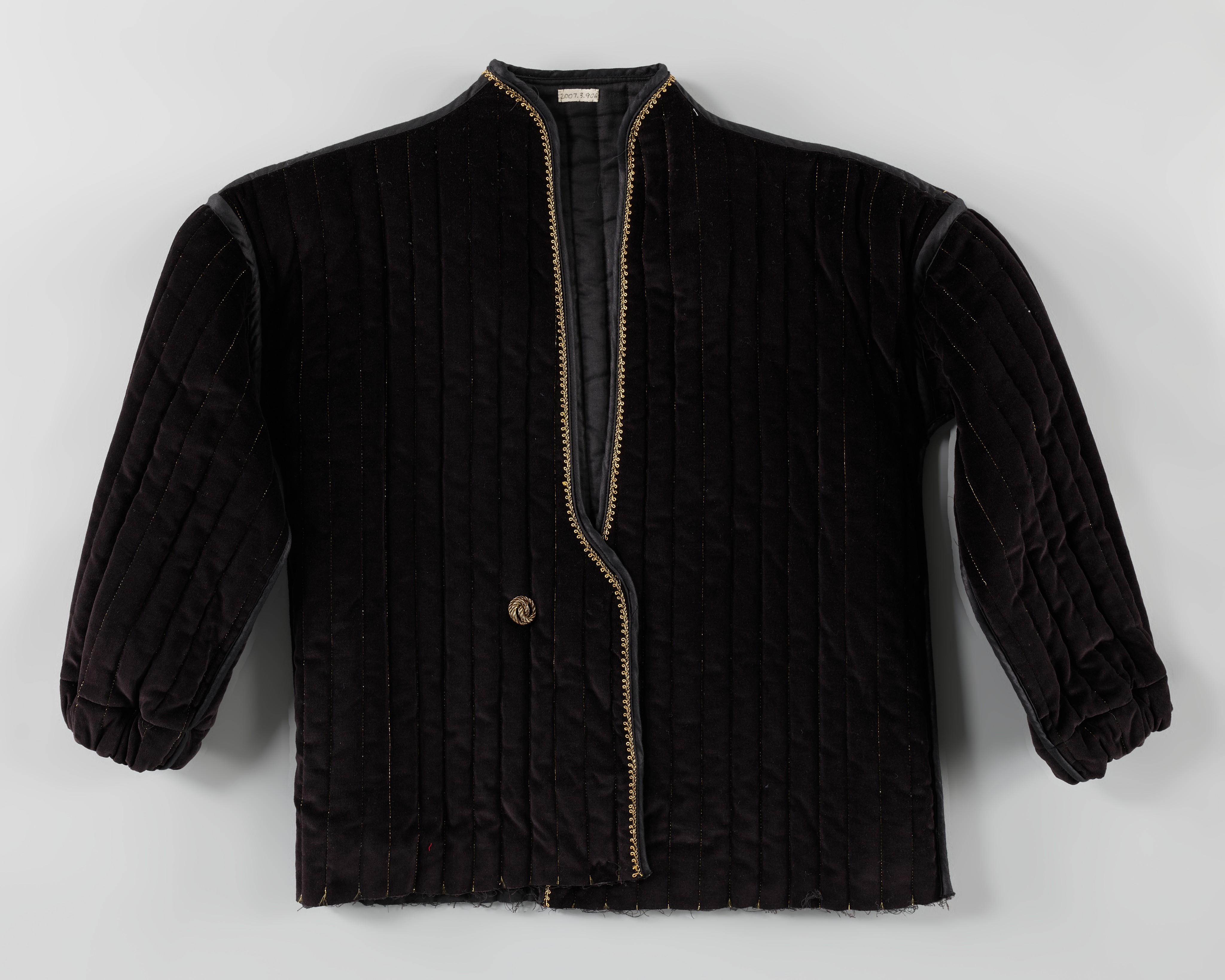
A black velvet quilted jacket with gold trim by Jay Smith. The jacket is composed of black velveteen fabric that has linear top stitching at regular intervals, creating a quilted effect. Two panels of fabric make up the front of the jacket and it features a rounded neckline that slightly curves upwards. At the mid-point of the bust, both center front panels overlap slightly with the right panel over the left. A gold metal button meant to resemble a coiled, braided rope is hand sewn to the proper right panel (at a later date, by a textile conservator) and there is no corresponding buttonhole on the proper left panel. Braided cord wrapped in metallic thread trims the neckline and center front opening. It is machine stitched into place in a looped pattern. Each sleeve is one panel and sewn to itself at the inner arm. There is a 1.75" cuff at the end of each sleeve, which a panel of elastic encased inside. All outside seams are encased with .5" black cotton twill tape. The bottom of the jacket is unfinished and has raw edges and the back of the jacket is made with one panel of quilted velveteen fabric. Black cotton twill lines the inside of the jacket and the interior construction mirrors that of the outside. There is no label.
|
{"key": "nmaahc_NMAAHC-2007_3_906_001", "collection": "nmaahc", "tier": "tier1", "tier_path": "tier1/nmaahc", "record_id": "ld1-1767262347358-1767262350173-0", "type": "edanmdm", "title": "Black velvet quilted jacket with gold trim by Jay Smith", "date": "ca. 1982", "creator": "Jay Smith, American, 1942 - 1986 | Black Fashion Museum, American, 1979 - 2007", "medium": "velveteen, cotton twill, metallic thread, batting, cording, elastic, and metal | Length (collar to hem): 26 3/4 in. (67.9 cm) | Width (shoulder to shoulder): 22 3/4 in. (57.8 cm) | Chest (flat): 21 1/4 in. (54 cm) | Waist (flat): 20 1/2 in. (52.1 cm)", "place": "", "object_type": "coats | jackets", "topics": ["African American", "Clothing and dress", "Design", "Fashion", "Fashion design"], "credit_line": "Collection of the Smithsonian National Museum of African American History and Culture, Gift of the Black Fashion Museum founded by Lois K. Alexander-Lane", "data_source": "National Museum of African American History and Culture", "taxonomic_name": "", "notes_raw": [{"content": "A black velvet quilted jacket with gold trim by Jay Smith. The jacket is composed of black velveteen fabric that has linear top stitching at regular intervals, creating a quilted effect. Two panels of fabric make up the front of the jacket and it features a rounded neckline that slightly curves upwards. At the mid-point of the bust, both center front panels overlap slightly with the right panel over the left. A gold metal button meant to resemble a coiled, braided rope is hand sewn to the proper right panel (at a later date, by a textile conservator) and there is no corresponding buttonhole on the proper left panel. Braided cord wrapped in metallic thread trims the neckline and center front opening. It is machine stitched into place in a looped pattern. Each sleeve is one panel and sewn to itself at the inner arm. There is a 1.75” cuff at the end of each sleeve, which a panel of elastic encased inside. All outside seams are encased with .5” black cotton twill tape. The bottom of the jacket is unfinished and has raw edges and the back of the jacket is made with one panel of quilted velveteen fabric. Black cotton twill lines the inside of the jacket and the interior construction mirrors that of the outside. There is no label.", "label": "Description"}, {"content": "The Black Fashion Museum Collection holds a group of similar garments designed by Jay Smith: 2007.3.347, 2007.3.348, 2007.907, 2007.3.908.", "label": "Description"}], "scopecontent": "", "alt_text": "", "ext_descr": "Black velvet quilted jacket with gold trim by Jay Smith A black velvet quilted jacket with gold trim by Jay Smith. The jacket is composed of black velveteen fabric that has linear top stitching at regular intervals, creating a quilted effect. Two panels of fabric make up the front of the jacket and it features a rounded neckline that slightly curves upwards. At the mid-point of the bust, both center front panels overlap slightly with the right panel over the left. A gold metal button meant to resemble a coiled, braided rope is hand sewn to the proper right panel (at a later date, by a textile conservator) and there is no corresponding buttonhole on the proper left panel. Braided cord wrapped in metallic thread trims the neckline and center front opening. It is machine stitched into place in a looped pattern. Each sleeve is one panel and sewn to itself at the inner arm. There is a 1.75\" cuff at the end of each sleeve, which a panel of elastic encased inside. All outside seams are encased with .5\" black cotton twill tape. The bottom of the jacket is unfinished and has raw edges and the back of the jacket is made with one panel of quilted velveteen fabric. Black cotton twill lines the inside of the jacket and the interior construction mirrors that of the outside. There is no label.\nThe Black Fashion Museum Collection holds a group of similar garments designed by Jay Smith: 2007.3.347, 2007.3.348, 2007.907, 2007.3.908
|
4
|
00000003___nmaahc_NMAAHC-2014_61_27_001
|
|
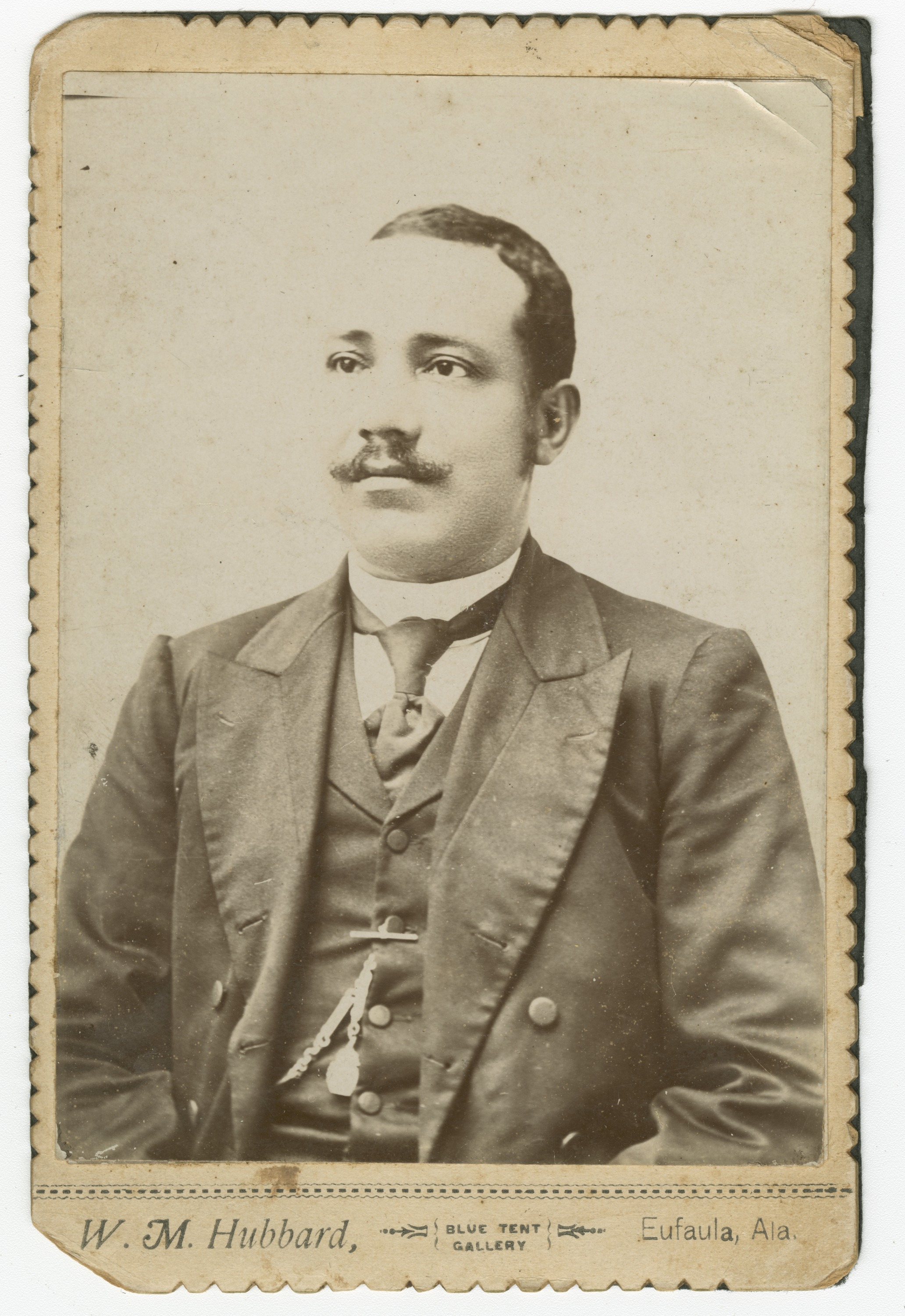
A black-and-white cabinet card photograph of a man wearing a dark colored jacket, vest and necktie. He has a mustache and a pocket watch chain is visible. The chain is connected to the second button from the top of his vest and extends behind his jacket on his right side. Printed at the bottom of the card beneath the photograph is "W. M. Hubbard," "BLUE TENT GALLERY" and "Eufaula, Ala." There are no inscriptions on front or back.
|
{"key": "nmaahc_NMAAHC-2014_61_27_001", "collection": "nmaahc", "tier": "tier1", "tier_path": "tier1/nmaahc", "record_id": "ld1-1643398738600-1643398749538-0", "type": "edanmdm", "title": "Photograph of a man wearing a dark colored suit with a pocket watch in his vest", "date": "1886-1900", "creator": "W. M. Hubbard, American | Blue Tent Gallery, American | Unidentified Man or Men | Hattie Durr Whiddon Graham, American, 1873 - 1950", "medium": "photographic gelatin and silver on photographic paper on card mounts | H x W (card): 6 1/2 x 4 1/4 in. (16.5 x 10.8 cm) | H x W (image): 5 1/2 x 3 7/8 in. (14 x 9.8 cm)", "place": "Eufaula, Barbour County, Alabama, United States, North and Central America", "object_type": "cabinet photographs | gelatin silver prints | portraits", "topics": ["African American", "American South", "Families", "Photography", "U.S. History, 1865-1921"], "credit_line": "Collection of the Smithsonian National Museum of African American History and Culture, Donated by Don L. Durrah and D. Simone Durrah Logan in memory of Hattie J. Durr Whiddon Graham (1873-1950); Christopher Columbus Wayman Whiddon (1894-1973); Lina Irene Jordan Whiddon (1897-1983)", "data_source": "National Museum of African American History and Culture", "taxonomic_name": "", "notes_raw": [{"content": "A black-and-white cabinet card photograph of a man wearing a dark colored jacket, vest and necktie. He has a mustache and a pocket watch chain is visible. The chain is connected to the second button from the top of his vest and extends behind his jacket on his right side. Printed at the bottom of the card beneath the photograph is “W. M. Hubbard,” “BLUE TENT / GALLERY” and “Eufaula, Ala.” There are no inscriptions on front or back.", "label": "Description"}], "scopecontent": "", "alt_text": "", "ext_descr": "Photograph of a man wearing a dark colored suit with a pocket watch in his vest A black-and-white cabinet card photograph of a man wearing a dark colored jacket, vest and necktie. He has a mustache and a pocket watch chain is visible. The chain is connected to the second button from the top of his vest and extends behind his jacket on his right side. Printed at the bottom of the card beneath the photograph is \"W. M. Hubbard,\" \"BLUE TENT / GALLERY\" and \"Eufaula, Ala.\" There are no inscriptions on front or back. H x W (card): 6 1/2 x 4 1/4 in. (16.5 x 10.8 cm)\nH x W (image): 5 1/2 x 3 7/8 in. (14 x 9.8 cm)", "caption_source": "notes", "grounding_prompt": "", "guid": "http://n2t.net/ark:/65665/fd57ce66bc7-cf0a-4b04-835d-70c983ad0097", "license": "CC0", "image_path": "/capstor/store/cscs/swissai/infra01/vision-datasets/raw/cooldown/s3___smithsonian___OpenAccess/media/nmaahc/NMAAHC-2014_61_27_001.jpg", "image_width": 2064, "image_height": 3000, "all_idsIds": ["NMAAHC-2014_61_27_001", "NMAAHC-2014_61_27_002"], "renders": {}}
|
5
|
00000004___nmaahc_NMAAHC-2016_35_3001
|
|
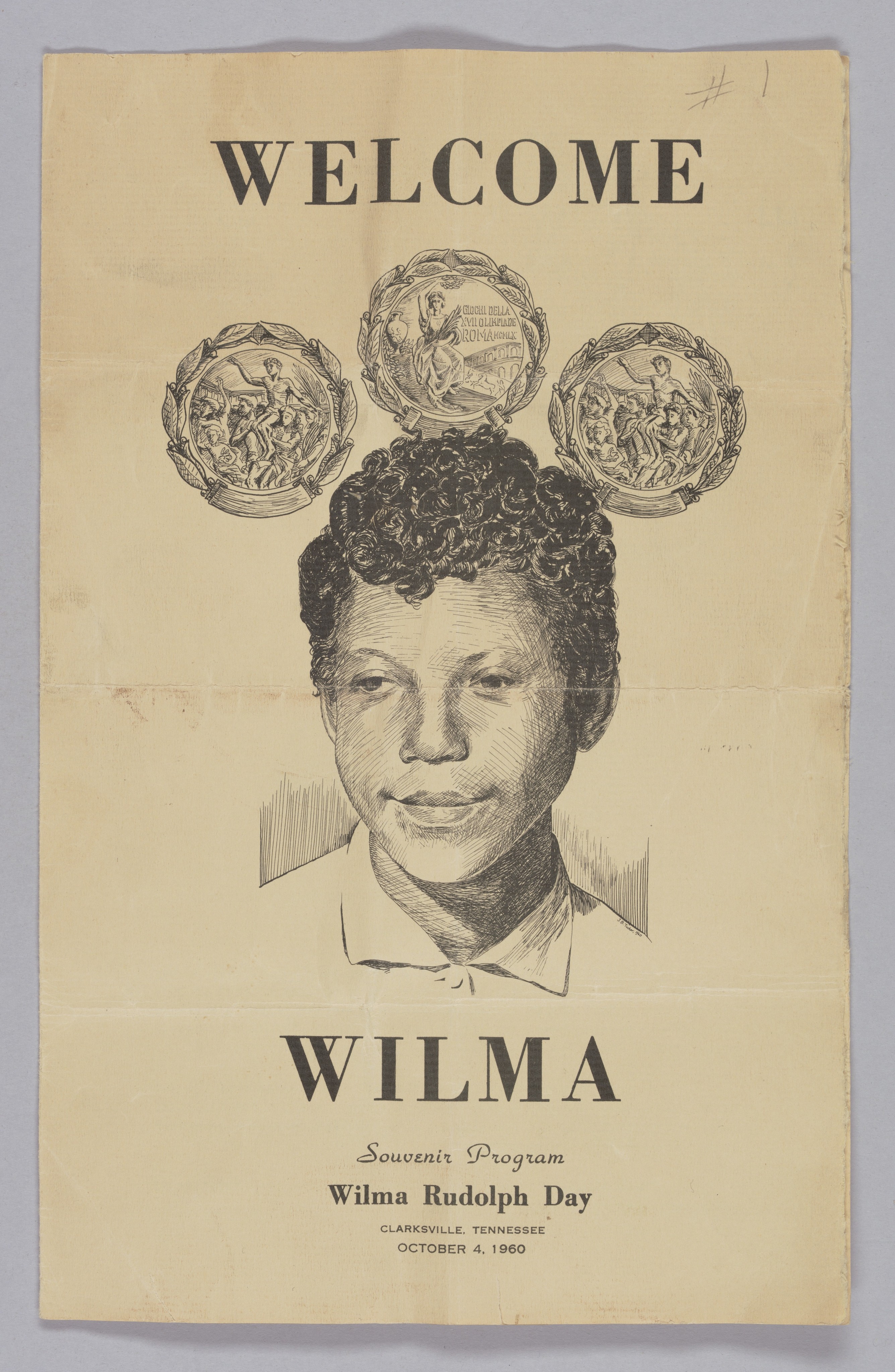
A souvenir program celebrating Wilma Rudolph Day in Clarksville, Tennessee on October 4, 1960, commemorating her achievements in the 1960 Summer Olympics. The front of the black-and-white program features a centrally oriented, hatched illustration of Wilma Rudolph with three Olympic gold medals above her head. At the top of the program is the text "WELCOME" centered above the illustration. At the bottom of the front cover is text that reads "WILMA / Souvenir Program / Wilma Rudolph Day / Clarksville, Tennessee / October 4, 1960". The program has two interior pages. The left interior page features an illustration of a plaque by the Citizens of Clarksville in honor of Rudolph's gold medals, a second illustration of a proclamation by the Mayor of Clarksville naming October 4, 1960 "WELCOME WILMA DAY", and an illustration of three Olympic gold medals. Below the illustrations are three paragraphs of text that give the background of the event and the names of other honored medalists. The right interior page lists a Program of Events. The back of the program is a list of sponsors. There is a handwritten notation in pencil in the top right corner of the front cover. There are handwritten notations, speech times, and check marks in blue ink on the interior right page.
|
{"key": "nmaahc_NMAAHC-2016_35_3001", "collection": "nmaahc", "tier": "tier1", "tier_path": "tier1/nmaahc", "record_id": "ld1-1643398738600-1643398751065-0", "type": "edanmdm", "title": "Souvenir program for Wilma Rudolph Day", "date": "October 4, 1960", "creator": "Wilma Rudolph, American, 1940 - 1994 | Unidentified", "medium": "ink on paper | H x W: 10 13/16 × 6 7/8 in. (27.5 × 17.5 cm)", "place": "Clarksville, Montgomery County, Tennessee, United States, North and Central America", "object_type": "souvenir programs", "topics": ["African American", "American South", "Athletes", "Communities", "Olympics", "Race relations", "Sports", "Track and field", "Women"], "credit_line": "Collection of the Smithsonian National Museum of African American History and Culture, Gift of the Rudolph Family in memory of Wilma Rudolph", "data_source": "National Museum of African American History and Culture", "taxonomic_name": "", "notes_raw": [{"content": "A souvenir program celebrating Wilma Rudolph Day in Clarksville, Tennessee on October 4, 1960 commemorating her achievements in the 1960 Summer Olympics. The front of the black-and-white program features a centrally oriented, thatched illustration of Wilma Rudolph with three (3) Olympic gold medals above her head. At the top of the program is the text [WELCOME] centered above the illustration. At the bottom of the front cover is text that reads [WILMA / Souvenir Program / Wilma Rudolph Day / Clarksville Tennessee / October 4, 1960]. The program has two (2) interior pages. The left interior page features an illustration of a plaque by the Citizens of Clarksville in honor of Rudolph’s gold medals, a second illustration of a proclamation by the Mayor of Clarksville naming October 4, 1960 [WELCOME WILMA DAY], and an illustration of three (3) Olympic gold medals. Below the illustrations are three paragraphs of text that give the background of the event and the names of other honored medalists. The right interior page lists a Program of Events. The back of the program is a list of sponsors. There is a handwritten notation in pencil in the top left corner of the front cover. There are handwritten notations, speech times, and check marks in blue ink on the interior right page.", "label": "Description"}], "scopecontent": "", "alt_text": "", "ext_descr": "Souvenir program for Wilma Rudolph Day A souvenir program celebrating Wilma Rudolph Day in Clarksville, Tennessee on October 4, 1960 commemorating her achievements in the 1960 Summer Olympics. The front of the black-and-white program features a centrally oriented, thatched illustration of Wilma Rudolph with three (3) Olympic gold medals above her head. At the top of the program is the text [WELCOME] centered above the illustration. At the bottom of the front cover is text that reads [WILMA / Souvenir Program / Wilma Rudolph Day / Clarksville Tennessee / October 4, 1960]. The program has two (2) interior pages. The left interior page features an illustration of a plaque by the Citizens of Clarksville in honor of Rudolph's gold medals, a second illustration of a proclamation by the Mayor of Clarksville naming October 4, 1960 [WELCOME WILMA DAY], and an illustration of three (3) Olympic gold medals. Below the illustrations are three paragraphs of text that give the background of the event and the names of other honored medalists. The right interior page lists a Program of Events. The back of the program is a list of sponsors. There is a handwritten notation in pencil in the top left corner of the front cover. There are handwritten notations, speech times, and check marks in blue ink on the interior right page. H x W: 10 13/16 × 6 7/8 in. (27.5 × 17.5 cm)", "caption_source": "notes", "grounding_prompt": "", "guid": "http://n2t.net/ark:/65665/fd540277c42-12ad-498c-a2aa-c7771b8e48f3", "license": "CC0", "image_path": "/capstor/store/cscs/swissai/infra01/vision-datasets/raw/cooldown/s3___smithsonian___OpenAccess/media/nmaahc/NMAAHC-2016_35_3001.jpg", "image_w
|
6
|
00000005___nmaahc_NMAAHC-2014_37_13_3_001
|
|
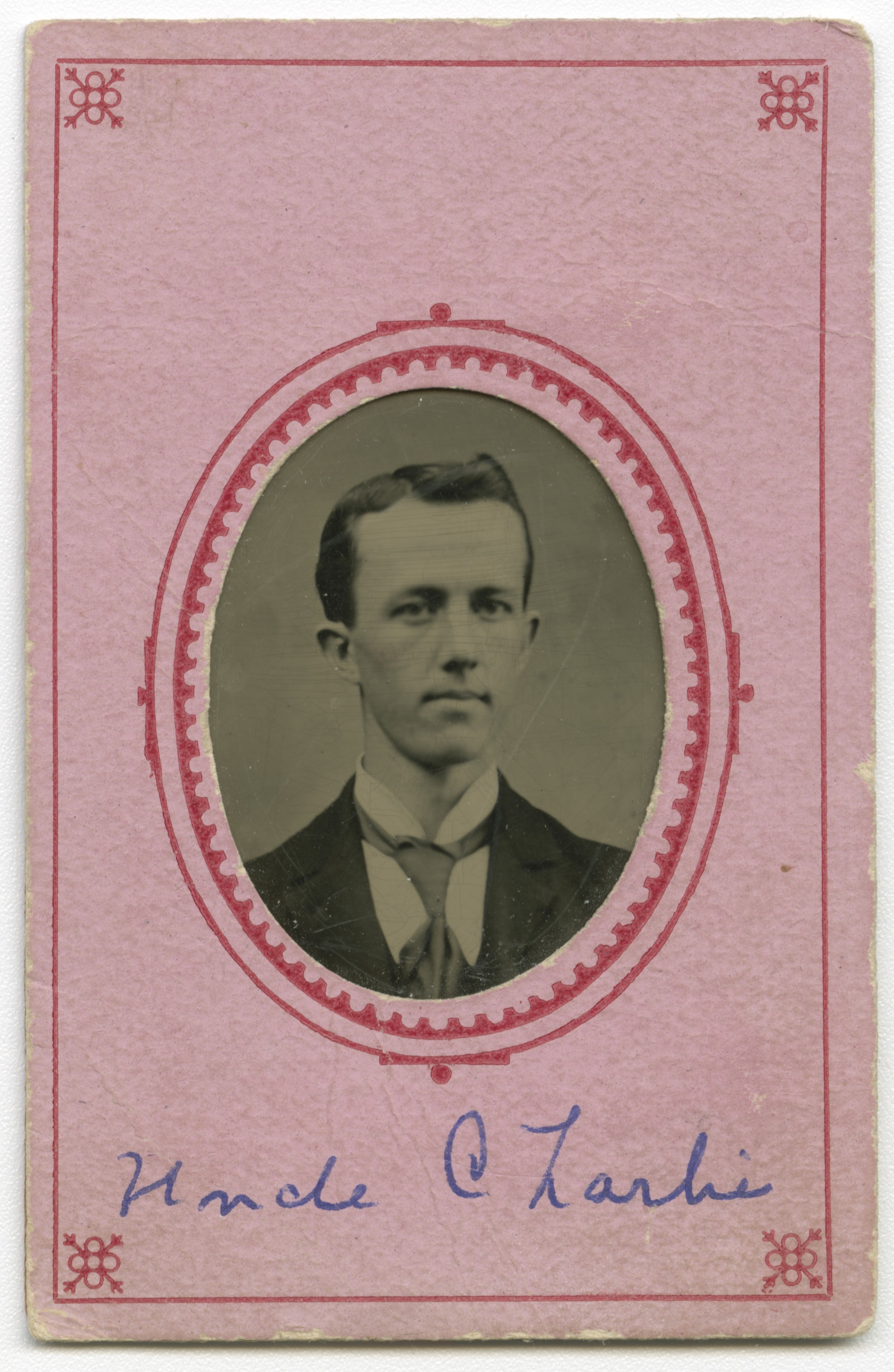
A tintype portrait of a man identified as "Uncle Charlie," captured by photographer John Green and mounted in pink paper matting. The man is featured wearing a light shirt with a collar, a dark coat, and tie. He is shown in the oval window of a rectangular paper matting. The pink matting has an oval window, surrounded by a patterned red border. The sides of the matting are also edged in a red border, with designs at the corners. There is an inscription under the oval that reads [Uncle Charlie]. The back of the matting is stamped with an oval stamp, the border of which matches the border decoration around the image window. Inside the border are the words [John Green / PHOTOGRAPHER / Cor. 18th & Market Sts. / Denver Colorado].
|
{"key": "nmaahc_NMAAHC-2014_37_13_3_001", "collection": "nmaahc", "tier": "tier1", "tier_path": "tier1/nmaahc", "record_id": "ld1-1696063492069-1696063499979-1", "type": "edanmdm", "title": "Tintype of a man identified as \"Uncle Charlie\"", "date": "ca. 1900", "creator": "John Green, American | Unidentified Man or Men", "medium": "collodion and silver on iron with lacquer with ink paper | H x W (image): 1 1/4 × 15/16 in. (3.2 × 2.4 cm) | H x W (card): 2 3/4 × 1 3/4 in. (7 × 4.4 cm)", "place": "Denver, Colorado, United States, North and Central America", "object_type": "tintypes | portraits", "topics": ["African American", "American West", "Business", "Photography"], "credit_line": "Collection of the Smithsonian National Museum of African American History and Culture", "data_source": "National Museum of African American History and Culture", "taxonomic_name": "", "notes_raw": [{"content": "John Green was a Black photographer who owned a photography studio in Denver, Colorado that he operated in the late 1800s and early 1900s.", "label": "Caption"}, {"content": "A tintype portrait of a man identified as \"Uncle Charlie,\" captured by photographer John Green and mounted in pink paper matting. The man is featured wearing a light shirt with a collar, a dark coat, and tie. He is show in the oval window of a rectangular paper matting. The pink matting has an oval window, surrounded by a patterned red border. The sides of the matting are also edged in a red border, with designs at the corners. There is an inscription under the oval that reads [Uncle Charlie]. The back of the matting is stamped with an oval stamp, the boarder of which matches the border decoration around the image window. Inside the border are the words [John Green / PHOTOGRAPHER / Cor. 18th & Market Sts. / Denver Colorado]. There is bright red sticker with the number [889] adhered to the back of the card.", "label": "Description"}], "scopecontent": "", "alt_text": "", "ext_descr": "Tintype of a man identified as \"Uncle Charlie\" A tintype portrait of a man identified as \"Uncle Charlie,\" captured by photographer John Green and mounted in pink paper matting. The man is featured wearing a light shirt with a collar, a dark coat, and tie. He is show in the oval window of a rectangular paper matting. The pink matting has an oval window, surrounded by a patterned red border. The sides of the matting are also edged in a red border, with designs at the corners. There is an inscription under the oval that reads [Uncle Charlie]. The back of the matting is stamped with an oval stamp, the boarder of which matches the border decoration around the image window. Inside the border are the words [John Green / PHOTOGRAPHER / Cor. 18th & Market Sts. / Denver Colorado]. There is bright red sticker with the number [889] adhered to the back of the card. H x W (image): 1 1/4 × 15/16 in. (3.2 × 2.4 cm)\nH x W (card): 2 3/4 × 1 3/4 in. (7 × 4.4 cm)", "caption_source": "notes", "grounding_prompt": "", "guid": "http://n2t.net/ark:/65665/fd5dcdb082d-fd60-43bf-b666-955a7abfae37", "license": "CC0", "image_path": "/capstor/store/cscs/swissai/infra01/vision-datasets/raw/cooldown/s3___smithsonian___OpenAccess/media/nmaahc/NMAAHC-2014_37_13_3_001.jpg", "image_width": 4515, "image_height": 6928, "all_idsIds": ["NMAAHC-2014_37_13_3_001", "NMAAHC-2014_37_13_3_002"], "renders": {}}
|
7
|
00000006___nmaahc_NMAAHC-2011_104_76_001
|
|
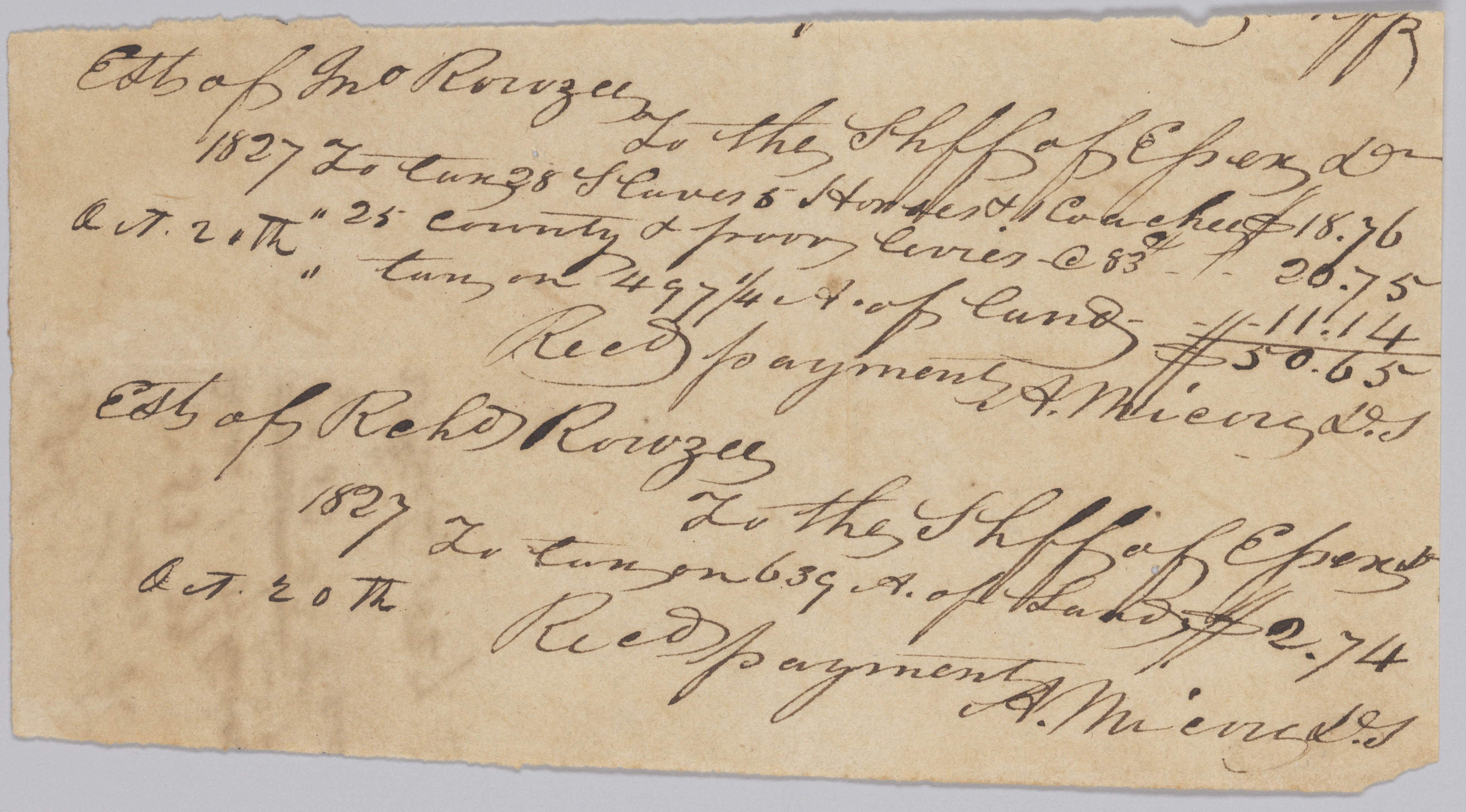
Record of taxable property, including enslaved persons, owned by Rouzee estates. This handwritten, single page document is an accounting of taxes owed to the Sheriff of Essex County by the estates of John and Richard Rouzee for the year 1827, recorded in two separate entries. The taxable property for the John Rouzee estate is listed as "28 slaves, 5 horses and 1 Coachee," twenty-five (25) county and poor levies at eighty-three (83) cents each, and four hundred and ninety-seven (497) acres of land. The taxable property for the Richard Rouzee estate is listed as six hundred and thirty-nine (639) acres of land. For each entry it is noted that payment was received on October 20, 1827, signed by A. Mievny. Writing on the reverse notes the date and amount paid. Both sides are written in black ink. Writing is partially visible at the top of the document, where the paper has been unevenly torn.
|
{"key": "nmaahc_NMAAHC-2011_104_76_001", "collection": "nmaahc", "tier": "tier1", "tier_path": "tier1/nmaahc", "record_id": "ld1-1643398738600-1643398743803-0", "type": "edanmdm", "title": "Record of taxable property, including enslaved persons, owned by Rouzee estates", "date": "October 20, 1827", "creator": "Rouzee Family, American", "medium": "ink on paper | L x W: 4 x 7 3/8 in. (10.2 x 18.7 cm)", "place": "Essex County, Virginia, United States, North and Central America", "object_type": "financial records | tax records", "topics": ["African American", "Agriculture", "Business", "Finance", "Law", "Slavery"], "credit_line": "Collection of the Smithsonian National Museum of African American History and Culture, Gift of Liljenquist Family", "data_source": "National Museum of African American History and Culture", "taxonomic_name": "", "notes_raw": [{"content": "This document is from a collection of financial papers related to the plantation operations of several generations of the Rouzee Family in Essex County, Virginia. The papers date from the 1790s through 1860.", "label": "Caption"}, {"content": "This handwritten, single page document is an accounting of taxes owed to the Sheriff of Essex County by the estates of John and Richard Rouzee for the year 1827, recorded in two separate entries. The taxale property for the John Rouzee estate is listed as \"28 slaves, 5 horses and 1 Coachee,\" twenty-five (25) county and poor levies at eighty-three (83) cents each, four hundred and ninety-seven (497) acres of land. The taxable property for the Richard Rouzee estate is listed as six hundred and thirty-nine (639) acres of land. For each entry it is noted that payment was received on October 20, 1827, signed by A. Mievny. Writing on the reverse notes the date and amount paid. Both sides are written in black ink. Writing is partially visible at the top of the document, where the paper has been unevenly torn.", "label": "Description"}, {"content": "Transcribed by digital volunteers", "label": "Transcription Center Status"}], "scopecontent": "", "alt_text": "", "ext_descr": "Record of taxable property, including enslaved persons, owned by Rouzee estates This handwritten, single page document is an accounting of taxes owed to the Sheriff of Essex County by the estates of John and Richard Rouzee for the year 1827, recorded in two separate entries. The taxale property for the John Rouzee estate is listed as \"28 slaves, 5 horses and 1 Coachee,\" twenty-five (25) county and poor levies at eighty-three (83) cents each, four hundred and ninety-seven (497) acres of land. The taxable property for the Richard Rouzee estate is listed as six hundred and thirty-nine (639) acres of land. For each entry it is noted that payment was received on October 20, 1827, signed by A. Mievny. Writing on the reverse notes the date and amount paid. Both sides are written in black ink. Writing is partially visible at the top of the document, where the paper has been unevenly torn. L x W: 4 x 7 3/8 in. (10.2 x 18.7 cm)", "caption_source": "notes", "grounding_prompt": "", "guid": "http://n2t.net/ark:/65665/fd57d521e0e-4472-4627-8a29-ed8d12b4d55e", "license": "CC0", "image_path": "/capstor/store/cscs/swissai/infra01/vision-datasets/raw/cooldown/s3___smithsonian___OpenAccess/media/nmaahc/NMAAHC-2011_104_76_001.jpg", "image_width": 5171, "image_height": 2866, "all_idsIds": ["NMAAHC-2011_104_76_001", "NMAAHC-2011_104_76_002"], "renders": {}}
|
8
|
00000007___nmaahc_NMAAHC-2011_43_1_001-000002
|
|
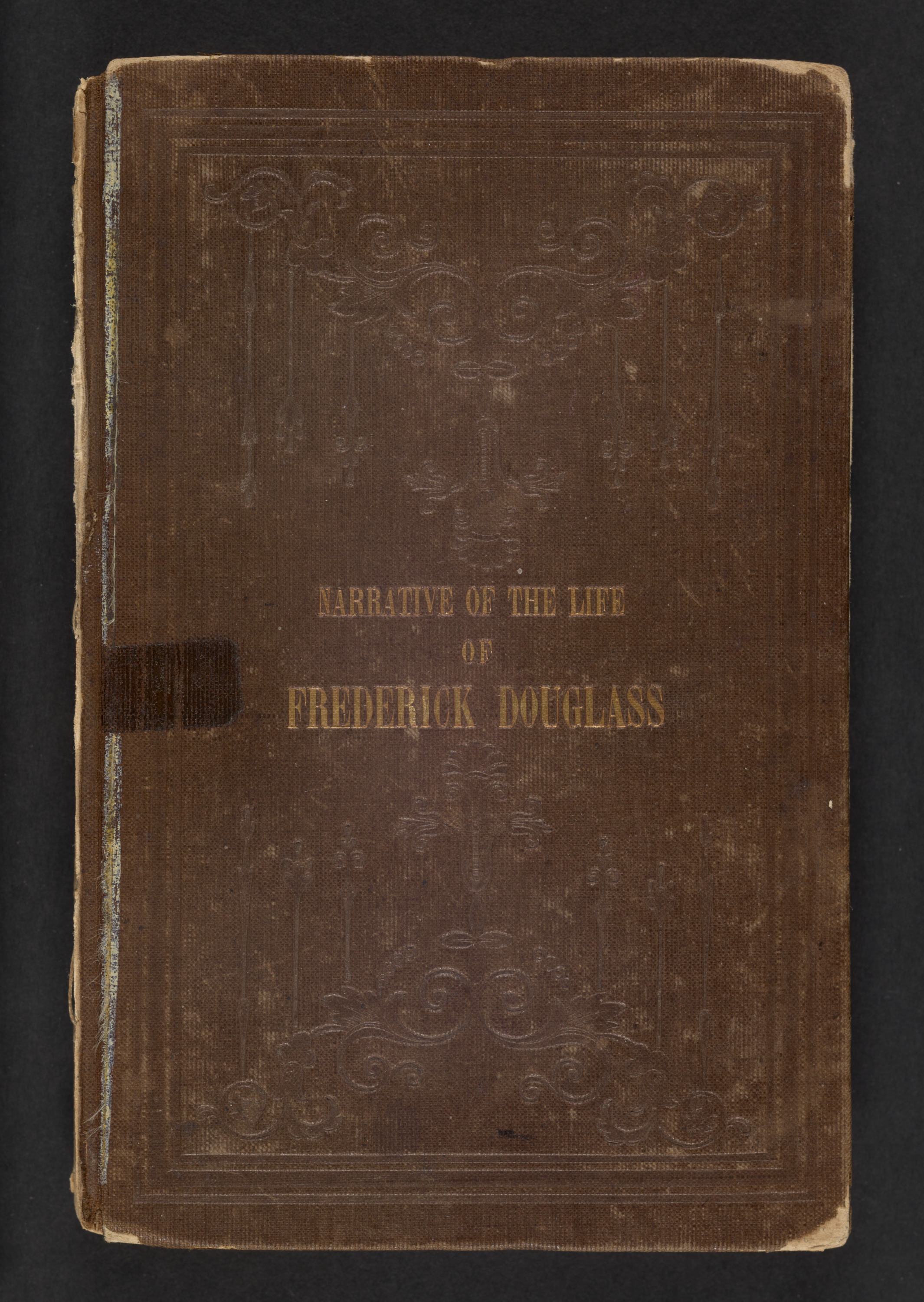
A first edition copy of the memoir and antislavery book Narrative of the Life of Frederick Douglass, An American Slave, Written by Himself. The hardcover book has a brown cover with an imprinted decorative border and scrollwork. The title is stamped in gold lettering in the center: NARRATIVE OF THE LIFE OF FREDERICK DOUGLASS. The frontispiece illustration is a portrait of Douglass, seated at a table, wearing jacket, vest, and tie, with his hands crossed in his lap. The first page prints the full title in alternating large and small type: NARRATIVE OF THE LIFE OF FREDERICK DOUGLASS, AN AMERICAN SLAVE. WRITTEN BY HIMSELF. The last part of the title appears between two horizontal lines. At the bottom center is the publishing information: BOSTON: PUBLISHED AT THE ANTI-SLAVERY OFFICE, No. 25 CORNHILL 1845. The book has a preface written by William Lloyd Garrison and a prefatory letter by Wendell Phillips. There are 125 pages.
|
{"key": "nmaahc_NMAAHC-2011_43_1_001-000002", "collection": "nmaahc", "tier": "tier1", "tier_path": "tier1/nmaahc", "record_id": "ld1-1643398738600-1643398745037-0", "type": "edanmdm", "title": "<I>Narrative of the Life of Frederick Douglass, an American Slave</I>", "date": "1845", "creator": "Frederick Douglass, American, 1818 - 1895 | Massachusetts Anti-Slavery Society, American, founded 1835 | William Lloyd Garrison, American, 1805 - 1879 | Wendell Phillips, American, 1811 - 1884", "medium": "ink on paper, cardboard | H x W x D: 7 x 4 1/2 x 5 in. (17.8 x 11.4 x 12.7 cm) | H x W x D (open at 90 degrees): 7 × 5 × 4 7/8 in. (17.8 × 12.7 × 12.4 cm) | H x W x D (open at 60 degrees): 7 × 5 × 4 1/4 in. (17.8 × 12.7 × 10.8 cm)", "place": "Boston, Suffolk County, Massachusetts, United States, North and Central America", "object_type": "narratives | hardcover books", "topics": ["African American", "Antislavery", "Freedom", "Fugitive enslaved", "Identity", "Literature", "Men", "Resistance", "Self-liberation", "Slavery", "U.S. History, 1815-1861"], "credit_line": "Collection of the Smithsonian National Museum of African American History and Culture, Gift of Elizabeth Cassell", "data_source": "National Museum of African American History and Culture", "taxonomic_name": "", "notes_raw": [{"content": "A first edition copy of the memoir and antislavery book Narrative of the Life of Frederick Douglass, An American Slave, Written by Himself. The hardcover book has a brown cover with an imprinted decorative border and scrollwork. The title is stamped in gold lettering in the center: [NARRATIVE OF THE LIFE / OF / FREDERICK DOUGLASS]. The frontispiece illustration is a portrait of Douglass, seated at a table, wearing jacket, vest, and tie, with his hands crossed in his lap. The first page prints the full title in alternating large and small type: [NARRATIVE / OF THE / LIFE / OF / FREDERICK DOUGLASS, / AN / AMERICAN SLAVE. / WRITTEN BY HIMSELF]. The last part of the title appears between two horizontal lines. At the bottom center is the publishing information: [BOSTON: / PUBLISHED AT THE ANTI-SLAVERY OFFICE, / No. 25 CORNHILL / 1845.]. The book has a preface written by William Lloyd Garrison and a prefatory letter by Wendell Phillips. There are 125 pages.", "label": "Description"}], "scopecontent": "", "alt_text": "", "ext_descr": "A first edition copy of the memoir and antislavery book Narrative of the Life of Frederick Douglass, An American Slave, Written by Himself. The hardcover book has a brown cover with an imprinted decorative border and scrollwork. The title is stamped in gold lettering in the center: [NARRATIVE OF THE LIFE / OF / FREDERICK DOUGLASS]. The frontispiece illustration is a portrait of Douglass, seated at a table, wearing jacket, vest, and tie, with his hands crossed in his lap. The first page prints the full title in alternating large and small type: [NARRATIVE / OF THE / LIFE / OF / FREDERICK DOUGLASS, / AN / AMERICAN SLAVE. / WRITTEN BY HIMSELF]. The last part of the title appears between two horizontal lines. At the bottom center is the publishing information: [BOSTON: / PUBLISHED AT THE ANTI-SLAVERY OFFICE, / No. 25 CORNHILL / 1845.]. The book has a preface written by William Lloyd Garrison and a prefatory letter by Wendell Phillips. There are 125 pages. H x W x D: 7 x 4 1/2 x 5 in. (17.8 x 11.4 x 12.7 cm)\nH x W x D (open at 90 degrees): 7 × 5 × 4 7/8 in. (17.8 × 12.7 × 12.4 cm)\nH x W x D (open at 60 degrees): 7 × 5 × 4 1/4 in. (17.8 × 12.7 × 10.8 cm)", "caption_source": "notes", "grounding_prompt": "", "guid": "http://n2t.net/ark:/65665/fd591fe36d9-f8c3-463c-9599-d71a955cbcaa", "license": "CC0", "image_path": "/capstor/store/cscs/swissai/infra01/vision-datasets/raw/cooldown/s3___smithsonian___OpenAccess/media/nmaahc/NMAAHC-2011_43_1_001-000002.jpg", "image_width": 2130, "image_height": 3000, "all_idsIds": ["NMAAHC-2011_43_1_001-000002", "NMAAHC-2011_43_1_002-000002", "NMAAHC-2011_43_1_003", "NMAAHC-2011_43_1_005", "NMA
|
9
|
00000008___nmaahc_NMAAHC-2021_16_22_3a_001
|
|
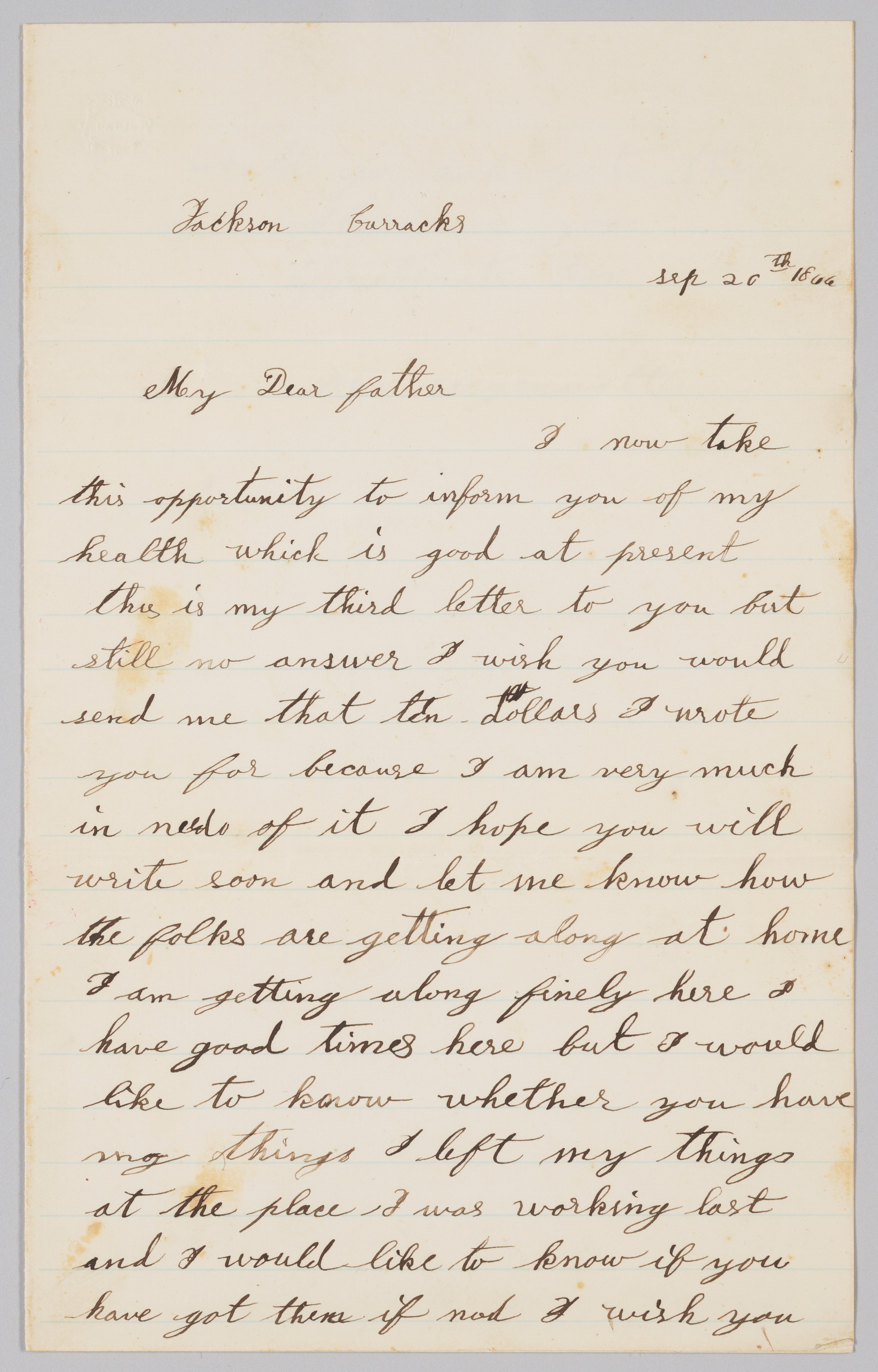
A letter written by John Stagenwalt, a 1st U.S. Infantry soldier stationed at New Orleans during its occupation by the Union Army. Written in brown ink on one sheet of lined wove paper folded to form four pages, the letter is addressed to John Sheaffer, of Bareville, Leacock Township, Pennsylvania, with the salutation [My Dear Father]. At top left is [Jackson Barracks] and at top right is [Sep. 20th 1866]. In the letter, Stagenwalt asks for Sheaffer to write and send him $10, as well as asking if Sheaffer has Stagenwalt's belongings. The second interior page and the fourth page are blank, with no writing or marks. The yellow envelope features a red three cents George Washington stamp on the front, is postmarked September 22, addressed to Mr. John Sheaffer, and has no markings on the reverse.
|
{"key": "nmaahc_NMAAHC-2021_16_22_3a_001", "collection": "nmaahc", "tier": "tier1", "tier_path": "tier1/nmaahc", "record_id": "ld1-1643398738600-1643398752646-0", "type": "edanmdm", "title": "Letter written by Union occupation soldier John Stagenwalt", "date": "September 20, 1866", "creator": "John Stagenwalt, American, 1843 - 1885 | John Sheaffer, American, born 1802 | United States Army, American, founded 1775", "medium": "ink on wove paper | H x W (a): 8 × 4 15/16 in. (20.3 × 12.6 cm) | H x W (b): 3 1/16 × 5 1/2 in. (7.7 × 13.9 cm)", "place": "New Orleans, Orleans Parish, Louisiana, United States, North and Central America | Bareville, Lancaster County, Pennsylvania, United States, North and Central America", "object_type": "envelopes | letters (correspondence)", "topics": ["African American", "Correspondence", "Families", "Military", "Reconstruction, U.S. History, 1865-1877"], "credit_line": "Collection of the Smithsonian National Museum of African American History and Culture", "data_source": "National Museum of African American History and Culture", "taxonomic_name": "", "notes_raw": [{"content": "A letter (a) with envelope (b) written by John Stagenwalt, a 1st U.S. Infantry soldier stationed at New Orleans during its occupation by the Union Army. Written in brown ink on one sheet of lined wove paper folded to form four pages, the letter is addressed to John Sheaffer, of Bareville, Leacock Township, Pennsylvania, with the salutation [My Dear Father]. At top left is [Jackson Barracks] and at top right is [Sep. 20th 1866]. In the letter, Stagenwalt asks for Sheaffer to write and send him $10, as well as asking if Sheaffer has Stagenwalt's belongings. The second interior page and the fourth page are blank, with no writing or marks. The yellow envelope (b) features a red three cents George Washington stamp on the front, is postmarked September 22, addressed to Mr. John Sheaffer, and has no markings on the reverse.", "label": "Description"}, {"content": "Transcribed by digital volunteers", "label": "Transcription Center Status"}], "scopecontent": "", "alt_text": "", "ext_descr": "Letter written by Union occupation soldier John Stagenwalt A letter (a) with envelope (b) written by John Stagenwalt, a 1st U.S. Infantry soldier stationed at New Orleans during its occupation by the Union Army. Written in brown ink on one sheet of lined wove paper folded to form four pages, the letter is addressed to John Sheaffer, of Bareville, Leacock Township, Pennsylvania, with the salutation [My Dear Father]. At top left is [Jackson Barracks] and at top right is [Sep. 20th 1866]. In the letter, Stagenwalt asks for Sheaffer to write and send him $10, as well as asking if Sheaffer has Stagenwalt's belongings. The second interior page and the fourth page are blank, with no writing or marks. The yellow envelope (b) features a red three cents George Washington stamp on the front, is postmarked September 22, addressed to Mr. John Sheaffer, and has no markings on the reverse. H x W (a): 8 × 4 15/16 in. (20.3 × 12.6 cm)\nH x W (b): 3 1/16 × 5 1/2 in. (7.7 × 13.9 cm)", "caption_source": "notes", "grounding_prompt": "", "guid": "http://n2t.net/ark:/65665/fd5a5f567f1-7f96-4121-96d1-bf7d990873db", "license": "CC0", "image_path": "/capstor/store/cscs/swissai/infra01/vision-datasets/raw/cooldown/s3___smithsonian___OpenAccess/media/nmaahc/NMAAHC-2021_16_22_3a_001.jpg", "image_width": 4163, "image_height": 6504, "all_idsIds": ["NMAAHC-2021_16_22_3a_001", "NMAAHC-2021_16_22_3a_002", "NMAAHC-2021_16_22_3a_003", "NMAAHC-2021_16_22_3b_001", "NMAAHC-2021_16_22_3b_002"], "renders": {}}
|
10
|
00000009___nmaahc_NMAAHC-2010_55_81_2_001
|
|
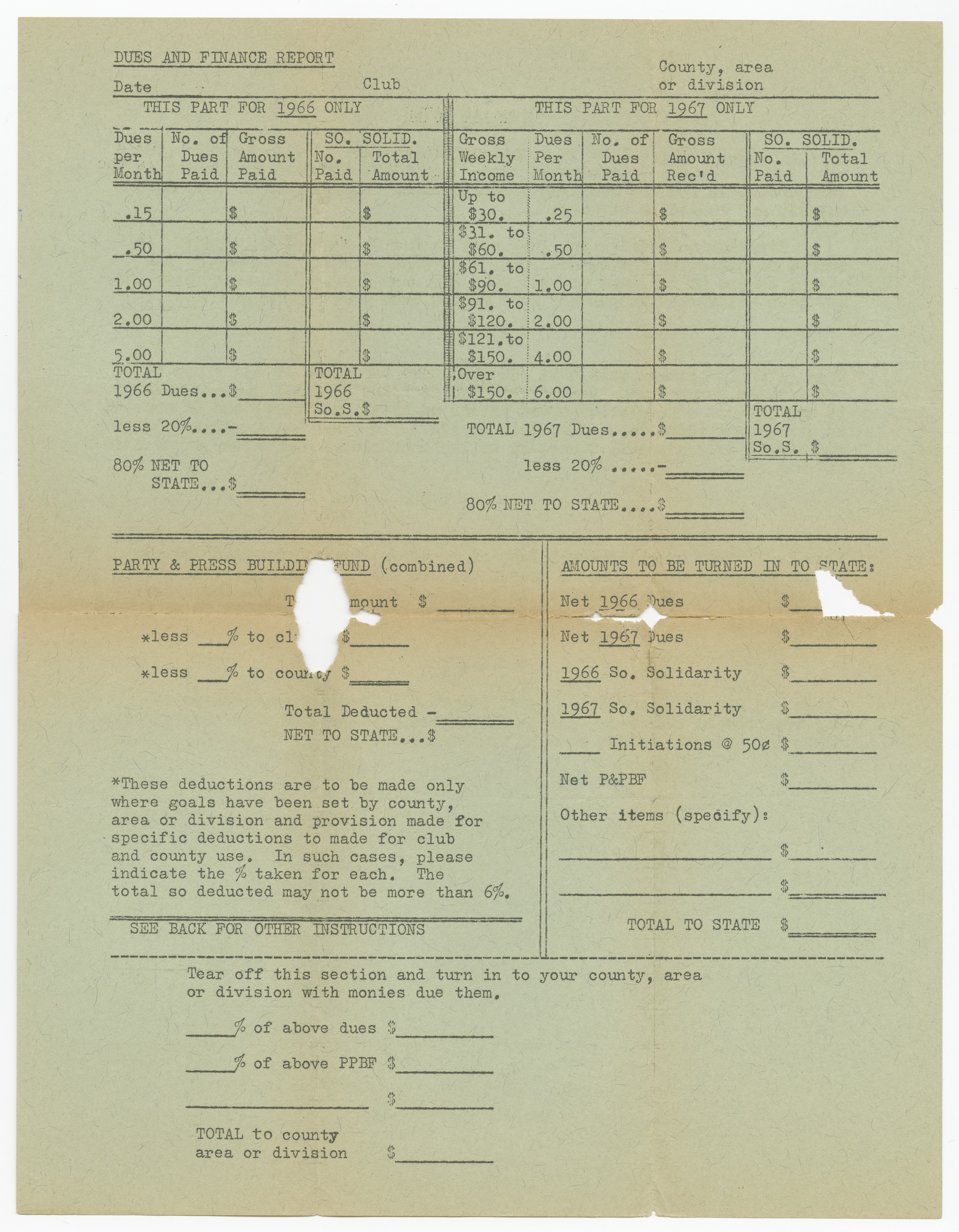
A "Dues and Finance Report" form for an unidentified organization, featuring structured tables for recording dues and finance data for the years 1966 and 1967. The document includes sections for calculating gross weekly income, dues paid, and solidarity amounts, as well as a section for "Party & Press Building Fund (combined)" and a list of amounts to be returned to the state.
|
{"key": "nmaahc_NMAAHC-2010_55_81_2_001", "collection": "nmaahc", "tier": "tier1", "tier_path": "tier1/nmaahc", "record_id": "ld1-1643398738600-1643398743314-1", "type": "edanmdm", "title": "Dues and finance report", "date": "ca. 1966", "creator": "Unidentified", "medium": "ink on paper", "place": "", "object_type": "forms (documents)", "topics": ["African American", "Associations and institutions", "Finance"], "credit_line": "Collection of the Smithsonian National Museum of African American History and Culture, Gift of the family of Dr. Maurice Jackson and Laura Ginsburg", "data_source": "National Museum of African American History and Culture", "taxonomic_name": "", "notes_raw": [{"content": "A \"Dues and Finance Report\" for an unidentified organization. The back of the document has some handwritten inscriptions.", "label": "Description"}], "scopecontent": "", "alt_text": "", "ext_descr": "Dues and finance report A \"Dues and Finance Report\" for an unidentified organization. The back of the document has some handwritten inscriptions.", "caption_source": "notes", "grounding_prompt": "", "guid": "http://n2t.net/ark:/65665/fd59fd0486f-4365-4988-a295-b3c82c715b45", "license": "CC0", "image_path": "/capstor/store/cscs/swissai/infra01/vision-datasets/raw/cooldown/s3___smithsonian___OpenAccess/media/nmaahc/NMAAHC-2010_55_81_2_001.jpg", "image_width": 5284, "image_height": 6787, "all_idsIds": ["NMAAHC-2010_55_81_2_001", "NMAAHC-2010_55_81_2_002"], "renders": {}}
|